
Xinjiang Tea Houses: Where Locals Gather & What to Order
The old teahouse on Ostangboyi Road in Kashgar has a wooden balcony that leans about three degrees towards the street. I have sat on it eleven times across five trips. The first visit was a mistake. I walked in at 14:20 on a Tuesday in July 2017, ordered by pointing, got handed a pot of something rust-coloured with a dried rose floating in it, and paid ¥8. Then I sat there for two hours because nobody asked me to leave and the old men next to me were playing a card game I could not follow.
That is the whole thing, really. A Xinjiang tea house is not a café. Nobody is optimising table turnover. You buy a pot, you occupy a spot, and the afternoon goes wherever it goes.
What a Chaykhana Actually Is
The Uyghur word is chaykhana. In Mandarin you will see 茶馆 on the sign, or sometimes just 茶 painted on glass. Structurally these places are simple: a raised platform with carpets, low tables, a samovar or a bank of thermoses at the back, and a man who has been running the place since the 1990s.
Age matters here in a way it does not in Chinese teahouse culture further east. The chaykhana is a men’s social institution first and a beverage business second. In Kashgar, in Hotan, in the older parts of Yarkant, the same regulars occupy the same corners. I once watched a man arrive at the Ostangboyi teahouse, nod at four people, sit down, and receive tea he never ordered. He clearly does that daily.
This does not mean visitors are unwelcome. It means you should read the room before you rearrange furniture. Sit at the edge. Take the seat you are offered rather than the one with the best photo angle.
North of the Tianshan the culture shifts. Kazakh and Hui tea drinking in Yining, Bole and Changji happens more often in family homes, restaurants, or the eight-treasure tea shops. The purpose-built public chaykhana is strongest in the south, along the old caravan corridor from Hami through Turpan, Kuqa, Aksu, Kashgar and Hotan. If you are heading that way, the food scene notes in our Yining food guide cover the northern equivalent.
What to Order (And What Everything Costs)
Menus are rare. Where they exist they are usually in Uyghur and Chinese, handwritten, taped to a pillar. Here is what actually gets served.
Kara Chay (Black Tea)
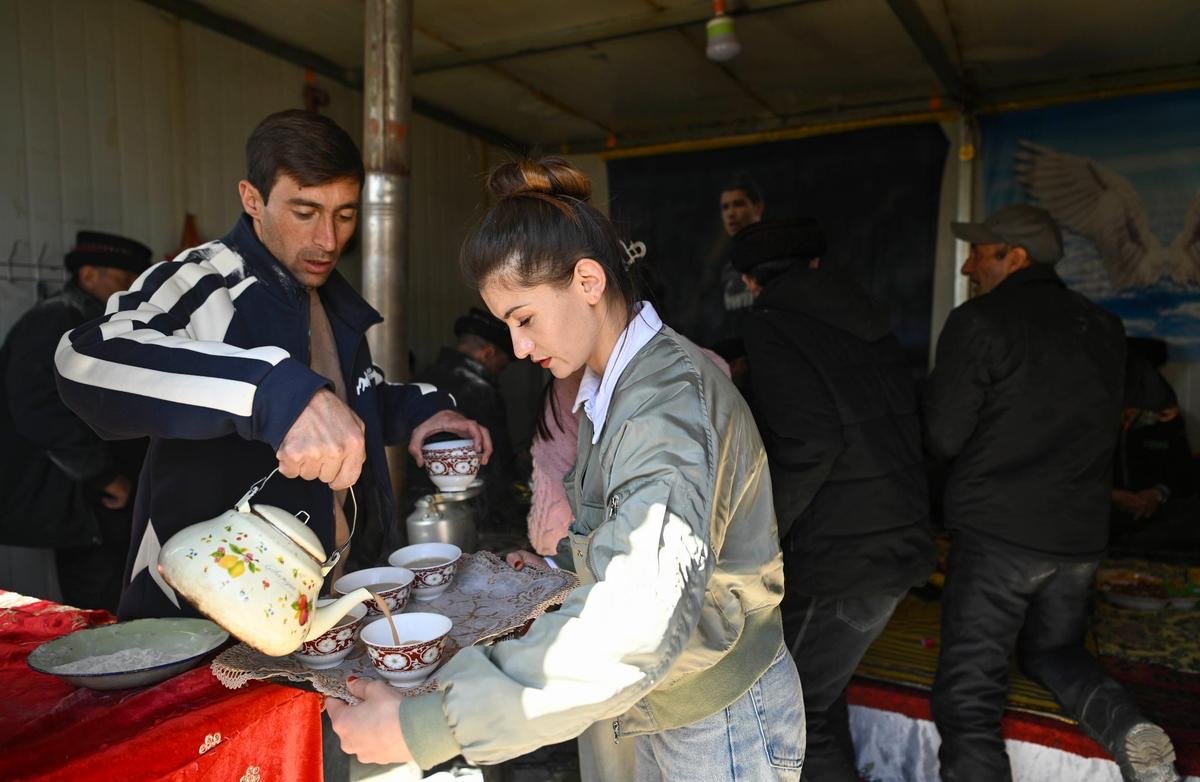
The default. Strong brick-style black tea, served in a small enamel or ceramic pot with a bowl. Expect ¥3 to ¥6 for a pot in a neighbourhood place, up to ¥15 in the tourist-adjacent spots inside Kashgar Old Town. Refills of hot water are free and unlimited. Say “su” while pointing at the pot and someone will top it up.
It is bitter. That is the point. It cuts lamb fat, which is why it appears next to every plate of grilled meat in the region.
Dora Chay (Medicinal Tea)
The interesting one. Dora means medicine. A pot of dora chay arrives loaded with some combination of dried rose petals, jujube, cardamom, cinnamon bark, saffron threads, walnut pieces, dried figs and rock sugar. Every teahouse has its own blend and every owner insists his is correct.
The version I keep going back to is at a small place two lanes east of the Id Kah Mosque square, where the pot comes with so much rose that the liquid turns pink after five minutes. It cost ¥12 in September 2024. In Hotan I paid ¥10 for a saffron-heavy pot that tasted closer to a hot dessert.
Price range across the region: ¥8 to ¥25. Anything above ¥30 is charging you for the view.
Süt Chay (Milk Tea)
Salted, not sweet. Brick tea boiled with milk, sometimes with butter or cream folded in, occasionally with a pinch of pepper. Kazakh households in the Ili Valley serve it constantly and will refill your bowl the second you put it down, which is a hospitality trap I have fallen into repeatedly. A bowl costs ¥3 to ¥8, or nothing at all if you are a guest.
If you want the full picture on milk tea, kumis and the rest of the drinking culture, I go deep on that in Xinjiang beverages beyond beer.
Eight-Treasure Tea
Hui Muslim tradition, strongest in Urumqi, Changji and Hami. Served in a lidded bowl called a gaiwan, packed with wolfberries, longan, jujube, chrysanthemum, sesame, raisins and rock sugar. Sweet. Around ¥10 to ¥18. You drink it by tilting the lid and sipping through the gap, never by removing the lid entirely.
The Etiquette That Actually Matters
Four things, learned mostly by getting them wrong.
The half-cup rule. Guests get their bowl filled roughly halfway, not to the brim. A full bowl in Uyghur and Kazakh custom is a hint that you have stayed long enough. When someone pours you half a bowl they are saying stay. I misread this as stinginess for about two years.
Receiving with the right hand. Left hand supporting the right forearm if you want to look properly respectful. Older men will notice and it changes the temperature of the interaction immediately.
Bread goes with tea, and bread is not thrown away. Naan is torn, never cut with a knife at the table, and never placed face down. If a piece falls on the floor, pick it up. I watched a teenager in Kuqa get quietly corrected by his grandfather for leaving a scrap on a bench.
Payment. Cash still works everywhere. WeChat Pay and Alipay QR codes are taped to most counters even in villages. You usually pay when you leave, at the counter, not at your table. Tipping is not a thing and attempts to tip create confusion.
Five Tea Houses I Keep Returning To
1. Ostangboyi Road Teahouse, Kashgar Old Town
The famous one, upstairs, wooden balcony over the street. Yes it appears in every documentary about Kashgar. It is still worth it, because the ground-floor regulars have not gone anywhere. Go at 09:30 rather than midday and the tour groups are absent. Pot of dora chay ¥15, kara chay ¥8. Musicians sometimes play in the late afternoon, unscheduled and unpaid. Full context on the neighbourhood in our Kashgar Old Town guide.
2. The Sunday Bazaar Teahouses, Hotan
Hotan’s Sunday market spills across several blocks and the teahouses around its edge are working canteens for traders. Plastic stools, no decor, tea at ¥3. I had a conversation there with a jade dealer conducted entirely through his son’s phone translator, which took forty minutes and covered mostly football.
3. Kazanchi Neighbourhood, Yining
Different flavour entirely. Russian-influenced pastel houses, Uyghur and Tatar families, tea served in home courtyards that operate semi-commercially in summer. Expect ¥20 to ¥40 including a plate of jam, bread and dried apricots. Season runs roughly May through September.
4. Grand Bazaar Area, Urumqi
The most tourist-shaped option, and prices show it at ¥25 to ¥45 a pot. Useful if you are transiting through and want a controlled introduction. The eight-treasure tea here is genuinely good. The atmosphere is a performance.
5. Roadside Chaykhana, Kuqa to Aksu Corridor
Not a specific address. Along G217 and the older G314 there are truck-stop teahouses every 40 or 50 kilometres, marked by a hand-painted teapot. Tea ¥2 to ¥5, always with a bed platform in the back where drivers nap. If you are driving the mountain section towards the Subash ruins above Kuqa, these are your only reliable stops.
Timing Your Visit
Xinjiang runs on two clocks. Official Beijing time governs trains, flights and government offices. Local time, two hours behind, governs when humans actually eat and socialise. A teahouse that “opens at 09:00” means 09:00 Beijing time, which feels like 07:00.
Practical rhythm I use:
- 08:30 to 10:30 Beijing time. Breakfast crowd, quiet, best for photography. Pairs naturally with the morning food routine described in our Uyghur breakfast guide.
- 12:00 to 15:00. Dead zone in summer. Heat pushes everyone indoors. Turpan teahouses in July are essentially shade infrastructure.
- 16:00 to 19:00. The real session. Card games, arguments, occasional dutar or rawap playing.
- After 21:00. Most chaykhana close. Night activity shifts to street food.
Friday changes everything. Midday prayers empty the teahouses near mosques for about ninety minutes, then refill them heavily. In Kashgar the streets around Id Kah between 13:00 and 15:00 on a Friday are worth seeing but not worth pushing into.
Solo Travellers: What to Expect
I have visited these places alone, with a friend, and once with a group of six. Alone works best.
Language is less of a barrier than you would think. The functional vocabulary is about eight words. Chay for tea, bir for one, rahmat for thank you, qanche pul for how much. Point at what another table has. Nobody expects fluency and the effort registers.
Women travelling alone: the traditional chaykhana is male-dominated, and in smaller towns you may be the only woman in the room. In my experience and in reports from women I have travelled with, the response is curiosity rather than hostility, and often an invitation to sit with a family group if one is present. Restaurant tea rooms and the Yining courtyard places are more mixed if you would prefer that. Sitting near the entrance rather than deep inside gives you an easy exit either way.
Photography: ask. A raised camera and a questioning look gets a yes maybe 60% of the time from older men, higher from younger people. A no is a no and does not sour the visit. I have been waved over to join the frame more often than I have been refused.
What Gets Eaten With Tea
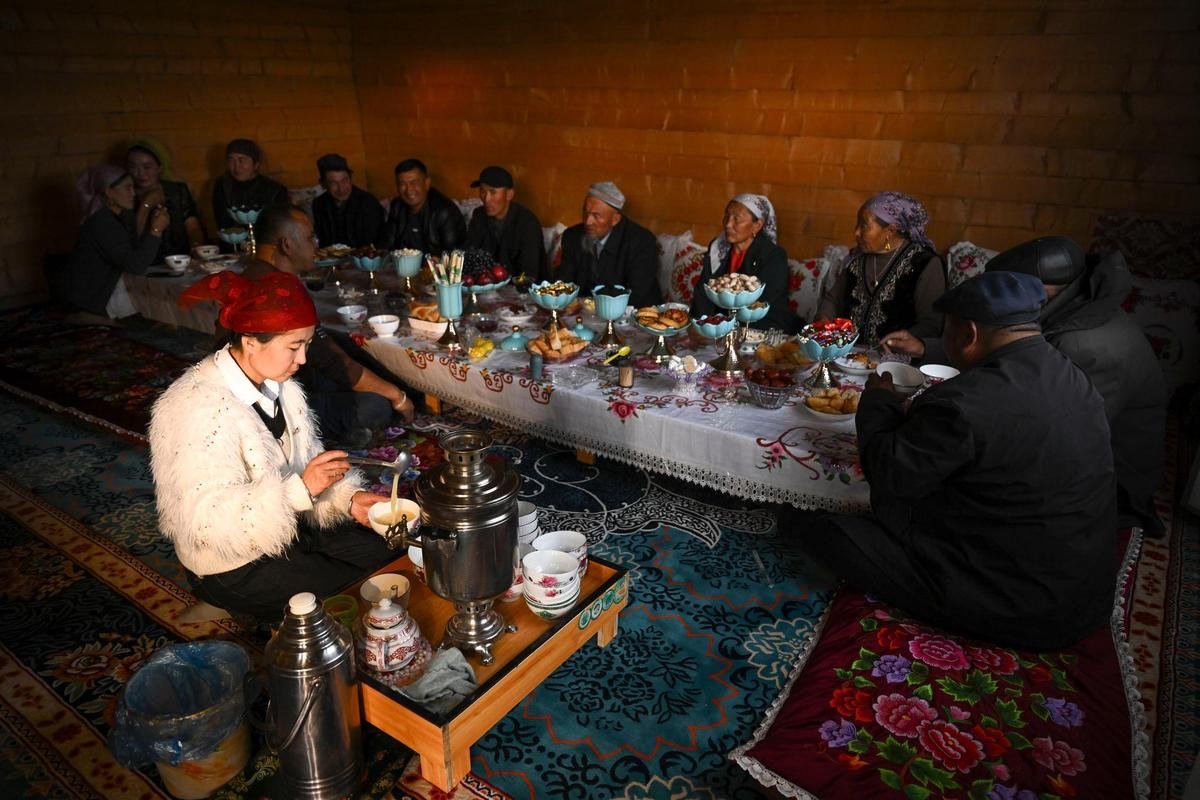
Most chaykhana serve little or no food. What appears is bread and things that sit next to bread. Naan, torn and dunked. Dried apricots and raisins from a shared bowl. Sunflower seeds. Sometimes samsa if there is a bakery next door, brought in by a kid for ¥4 each.
Some larger teahouses do run a kitchen and will produce lagman or polo. The quality is usually mediocre because food is not the point. Eat properly elsewhere, then come for tea. I make this mistake less often now.
Practical Notes
- Cash: carry ¥50 in small notes. Some village teahouses genuinely cannot break a ¥100.
- Toilets: assume there is not one. Plan around public facilities.
- Smoking: common indoors, no enforcement in practice.
- Alcohol: absent. These are Muslim social spaces.
- Duration: budget 90 minutes minimum. A 20-minute teahouse visit is a wasted teahouse visit.
- Cost per session: ¥10 to ¥30 all in, including bread.
One Last Thing
In March 2023 I sat in a teahouse in Yarkant for three hours during a dust storm because there was nowhere else to go. The owner refilled my pot four times and refused payment for the last two. When I finally left, visibility was maybe 80 metres and my tea had cost ¥6 total.
That is the arithmetic of the chaykhana. Almost no money, an unreasonable amount of time, and the single best way I know to stop being a tourist for an afternoon. Go early, order the dora chay, and do not plan anything for the next two hours.